

Most couples do not struggle because they have nothing to say — they struggle because what they say never quite lands. One partner hints and the other misses the hint. One raises their voice and the other shuts down. One needs a long talk and the other needs ten quiet minutes first. Good communication is not about talking more or talking perfectly; it is about making it safe and easy for both people to be honest, and then actually hearing what the other person means, not just the words they used.
Here are 34 practical ways to communicate better in a relationship, from the small daily habits that keep couples close to the exact words that defuse an argument, plus eight guides on what healthy communication really looks like, how to listen properly, how to say hard things without blame, and how to rebuild the conversation after a rough patch. Every idea comes with example phrases you can use tonight, signs it is working, and the mistakes to avoid — so you can stop having the same argument and start feeling like a team again.
What Good Communication Actually Looks Like in a Relationship

Good communication in a relationship is not constant deep conversation — it is the everyday flow of small, honest exchanges that keep two people on the same team. It looks like saying what you mean in plain words instead of hints, asking a real question and then waiting for the answer, and being able to disagree without either person feeling attacked. The tone matters as much as the words: a calm voice, open body language, and the feeling that your partner is genuinely glad to hear from you.
You can recognise it by how you feel afterwards. After a good conversation you feel lighter, even if the topic was difficult, because something was understood rather than won. Neither person walks away rehearsing what they wish they had said. If most of your talks end with one person frustrated and the other confused, the problem is rarely a lack of love — it is a lack of a shared way of talking, and that is something you can build together, one small change at a time.
Listening vs Waiting to Reply: The Skill That Changes Everything

Most of us think we are listening when we are actually just waiting for our turn to speak. While our partner talks, we are already building our reply, finding the flaw in their argument, or remembering the example that proves our point. Real listening is different: it means giving your full attention to what the other person is saying, including the feeling underneath the words, and letting them finish before you respond. It feels slower, and that is the point.
Try it as a small experiment this week: when your partner speaks, count to three in your head after they stop before you answer, and start your reply by reflecting what you heard — ‘So you felt overlooked when I made those plans without asking.’ You do not have to agree with everything you hear, but your partner needs to feel heard before they can hear you. Couples who master this one skill find that half their arguments simply never start.
How “I” Statements Actually Work (and When They Do Not)

An ‘I’ statement puts the focus on your own feeling instead of your partner’s behaviour: ‘I feel lonely when we spend the whole evening on our phones’ instead of ‘You always ignore me.’ The first opens a conversation; the second starts a defence. The formula is simple — I feel [emotion] when [specific situation] because [what it means to you] — and it works because it gives your partner something they can respond to without feeling accused.
It does not work when it is a ‘you’ statement in disguise: ‘I feel like you are selfish’ is still an accusation with a feeling word taped on top. Keep it about your own experience and a specific moment, not about your partner’s character. And remember that ‘I’ statements are a tool, not a magic spell — they help a good conversation go better, but they cannot fix a conversation where one person refuses to listen. Use them often, use them honestly, and pair them with genuine curiosity about how your partner feels too.
Timing Hard Conversations: When to Talk and When to Wait

The same words can land completely differently depending on when they are said. Bringing up a sore topic the moment your partner walks in from work, when one of you is hungry or exhausted, or in the middle of an already heated moment almost guarantees a bad result. The best time for a hard conversation is when you are both fed, rested, relatively calm, and have at least twenty unhurried minutes — not at midnight, not in the car, and not in front of other people.
That does not mean avoiding the conversation forever. Pick a time together instead of springing it: ‘There is something I would like to talk about — would after dinner work?’ gives your partner time to prepare instead of ambushing them. If a conversation starts going badly, it is also okay to pause it on purpose: ‘I want to get this right, can we take twenty minutes and come back to it?’ A planned pause is very different from storming off, and couples who learn to pause well argue far less destructively.
Communicating Your Needs Without Blame

Many people never actually state their needs — they hint, they hope, they test, and then they feel hurt when their partner fails a test they never knew they were taking. Stating a need plainly is not demanding or needy; it is generous, because it gives your partner a real chance to meet it. The trick is to name the need itself, not the failure: ‘I need more time together on weekends’ lands far better than ‘You never make time for me.’
It helps to name the need before it becomes a complaint. Once you are already resentful, almost anything you say will sound like blame, so catch needs early and say them small. ‘I would love it if we cooked together on Fridays’ is a wish; ‘You never help with anything’ is an accusation about the same thing. Your partner cannot read your mind, and most partners genuinely want to know what would make you happy — they just need you to say it in words they can act on.
Handling Conflict Without Shutting Down or Blowing Up

Every couple argues; healthy couples argue differently. The goal in a disagreement is not to win but to understand — to walk away knowing more about your partner than you did before. That means keeping the argument about one thing instead of dragging in every past grievance, speaking about the specific behaviour rather than your partner’s character, and remembering that the person across from you is your teammate, not your opponent.
When you feel yourself shutting down or heating up, name it out loud: ‘I am getting overwhelmed, I need a few minutes’ is far kinder than going silent or saying something cruel. Both partners need an exit that is not a punishment — a short, agreed pause with a clear time to return. And after the argument, repair matters more than who was right: a genuine apology, a small kindness, and a check-in the next day do more for a relationship than a perfect argument ever could.
Rebuilding Communication After a Rough Patch

After a bad stretch — a betrayal of trust, months of distance, or one fight too many — communication often feels stiff and guarded, and that is normal. Rebuilding does not start with one huge, dramatic talk; it starts with small, reliable moments of honesty that prove the other person is safe to talk to again. A daily check-in, a truthful answer to a small question, a kept promise — these are the bricks that rebuild trust one at a time.
Be patient with the pace. The partner who was hurt may need to bring something up more than once, and that is not punishment — it is how reassurance works. The partner who caused the hurt needs to listen without rushing the other person to ‘move on’. Progress looks like shorter silences, easier mornings, and conversations that end in a hug instead of a door closing. If you are stuck, a few sessions with a counsellor can give you both a shared language for the hard parts — asking for that help is a sign of strength, not failure.
Daily Habits That Keep Couples Talking

Long-term couples who communicate well rarely have one big secret — they have a dozen tiny habits. They greet each other properly when they come home. They ask about each other’s day and actually listen to the answer. They share a small moment of affection before bed, they say thank you out loud for ordinary things, and they check in during the day with a short message that says ‘I am thinking of you.’ None of these takes more than a minute, and together they keep the connection warm.
The habit that matters most is the one you will actually keep, so start small: pick one. A five-minute talk over coffee in the morning, a phone-free dinner, or a single question at bedtime — ‘What was the best part of your day?’ Build it into something you already do, and protect it like an appointment. Couples do not drift apart in one big moment; they drift apart in a thousand tiny missed chances to connect. Daily habits are how you catch those moments before they slip away.
1. Start With the Small Stuff Before the Big Stuff

Big, serious conversations go much better when the small talk is already flowing. Couples who chat easily about ordinary things — what happened at work, a funny thing the neighbour did, what to cook tonight — find it far easier to talk about money, feelings, and the future, because the habit of talking is already warm. If the only time you talk properly is when something is wrong, every conversation starts to feel like a confrontation.
What it means: everyday conversation is the foundation, not the filler. Why it matters: trust is built in small exchanges, so the big ones do not feel like ambushes. How to handle it: ask one open question a day that is not about chores — ‘What made you laugh today?’ or ‘What are you looking forward to?’ What to avoid: turning every small chat into a problem-solving session; sometimes your partner just wants to share, not to be fixed.
2. The 10-Minute Evening Talk Ritual

A short, regular talk at the end of the day does more for a relationship than an occasional three-hour heart-to-heart. Ten minutes, phones away, just the two of you: what happened today, how you are feeling, anything coming up tomorrow. It is short enough that nobody dreads it, and regular enough that nothing builds up into a crisis between talks. Think of it as daily maintenance, like brushing your teeth.
Try saying this: ‘Tell me the best and the hardest part of your day.’ Avoid saying this: ‘We need to talk’ — said with no context, it sounds like trouble. Signs it is working: you start looking forward to it, and the small irritations get mentioned the same day instead of exploding a week later. Keep it at the same time each evening so it becomes a habit, not a negotiation.
3. “I Feel” Statements in Real Life

Knowing the ‘I feel’ formula is one thing; using it in the middle of a real disagreement is another. It helps to practise it on small things first, when you are calm — ‘I feel rushed when we leave the house without a plan’ — so the words come naturally when the stakes are higher. The pattern is always the same: your feeling, the specific situation, and what you need, with no judgement about your partner’s character attached.
Try saying this: ‘I feel anxious when I do not know what time you will be home, because I worry something happened.’ Avoid saying this: ‘I feel like you do not care about me at all.’ The first gives your partner a clear, fixable problem; the second hands them an accusation they can only deny. If you catch yourself mid-sentence turning an ‘I feel’ into a ‘you always’, pause, breathe, and restart — your partner will notice the effort, and it matters.
4. Listening Without Rushing to Fix It

When your partner tells you about a hard day, your first instinct is usually to solve it — offer advice, suggest a fix, explain what they should have done. But most of the time, they do not want a solution yet; they want to feel understood first. Jumping straight to fixing can feel dismissive, as if their feelings are a problem to be solved rather than something worth hearing. Listening first, fixing second, changes the whole conversation.
What it means: your partner shares a feeling, and your job is to understand it before improving it. Why it matters: feeling heard is what makes people feel loved. How to handle it: ask one simple question before offering advice — ‘Do you want help fixing this, or do you just want me to listen?’ What to avoid: ‘Well, you should have…’ while they are still mid-story; save the solutions for after they feel heard.
5. Put the Phone Down: Giving Each Other Full Attention

Nothing says ‘you are not important right now’ quite like a partner who keeps glancing at their phone mid-conversation. It is a small habit with a big cost: every glance tells your partner that something else might matter more than they do. Putting the phone face-down, in another room, or on silent during your time together is one of the simplest and kindest communication upgrades a couple can make.
Try saying this: ‘Can we have a phone-free dinner tonight? I want to hear about your day properly.’ Avoid saying this: ‘You are always on your phone’ — said while you are also holding yours. Quick exercise: pick one phone-free hour a day and notice how much more you actually talk. The first few days feel strange; by the second week, most couples wonder why they waited so long.
6. Ask Instead of Assuming What They Meant

Most arguments are not about what happened — they are about what each person assumed the other meant. A short reply becomes ‘you are angry with me’, a forgotten errand becomes ‘you do not care’, a tired sigh becomes a judgement. Assumptions fill in the gaps with our worst fears, and then we argue with the story in our head instead of the person in front of us. Asking a simple question breaks the pattern.
What it means: when something feels off, check the meaning before reacting to it. Why it matters: one clarifying question can prevent an entire argument. How to handle it: ‘When you said that, I heard it as criticism — is that what you meant?’ What to avoid: mind-reading in the other direction too — ‘I know you think I am stupid’ puts words in your partner’s mouth that they never said. Curiosity beats certainty every time.
7. Say What You Need Clearly — No Mind-Reading Required

Expecting your partner to guess what you need is one of the most common — and most unfair — habits in a relationship. Hints feel safer than direct requests, but they are also far easier to miss, and the disappointment that follows is usually blamed on the partner who never got the message. Saying what you need in plain words is not demanding; it is the kindest thing you can do for both of you, because it gives your partner a real chance to get it right.
Try saying this: ‘I would really love it if we spent Saturday morning together, just us.’ Avoid saying this: ‘It would be nice if someone around here ever thought about what I want.’ The first is a clear, warm invitation; the second is a complaint disguised as a hint. Start with small, low-stakes requests and notice how often your partner happily says yes — that is the proof that directness works.
8. Talking About Money Without Starting a Fight

Money is one of the most common things couples argue about, and the arguments are rarely just about numbers — they are about security, freedom, and what each person values. The trick is to talk about money when things are calm, not when a bill has just arrived or a purchase has just been discovered. A regular, short money check-in — fifteen minutes a week — keeps small worries from becoming big resentments.
Try saying this: ‘Can we look at the budget together this weekend and plan the month?’ Avoid saying this: ‘You wasted money again.’ Signs it is working: you both know roughly what is coming in and going out, and neither of you dreads the conversation. Agree on a small amount each person can spend without asking, and treat the rest as a shared decision — it removes most of the friction at a stroke.
9. Dividing Chores Fairly — and Talking About It Without Nagging

Chores cause more arguments than most couples admit, because they are never really about the dishes — they are about feeling that the load is shared fairly. The fix is a conversation, not a scoreboard: sit down together, list everything that needs doing, and divide it by preference and time rather than by habit. The person who hates cooking should not automatically be the cook, and the person who works longer hours is not automatically exempt.
What it means: fairness is about the total load, including the invisible planning and remembering. Why it matters: feeling like the only one who notices what needs doing breeds resentment fast. How to handle it: agree the split together, write it down, and review it monthly. What to avoid: keeping a running tally of who did what — it turns a partnership into a competition, and nobody wins that one.
10. Handling Jealousy Honestly, Without Accusations

Jealousy is uncomfortable to admit, but it is also completely normal — and it becomes destructive only when it is hidden until it explodes, or expressed as an accusation. The healthy version sounds like this: ‘I felt insecure when you were texting your old friend late at night, and I would love some reassurance.’ That is honest, specific, and gives your partner something they can actually respond to with kindness.
Try saying this: ‘I felt a bit jealous earlier, and I think it is because I have been feeling distant from you lately.’ Avoid saying this: ‘Who were you texting? Let me see your phone.’ The first invites closeness; the second demands proof and starts a cycle of suspicion. If jealousy is frequent, ask what it is protecting — often it is not about the other person at all, but about feeling unsure of your place in the relationship.
11. Long-Distance Communication That Actually Keeps You Close

Long-distance couples live or die by how they communicate, because the relationship exists almost entirely in words, calls, and messages. The couples who make it work do not just text all day — they build small rituals: a morning message, a proper video call a few times a week, and shared experiences like watching the same film or cooking the same meal over a call. It is the quality and the regularity that matter, not the number of messages.
Try saying this: ‘Can we do a video call tonight? I miss seeing your face.’ Avoid saying this: replying to everything with ‘ok’ or ‘lol’ and wondering why the connection feels thin. Signs it is working: you know the small details of each other’s days, and the distance feels like a situation you are handling together, not a gap growing between you. Agree on how often you will talk, and be honest when you need more — or a little less — contact.
12. How to Apologise Properly (and Mean It)

A real apology has three parts: naming what you did, owning the impact, and saying what you will do differently. ‘I am sorry I raised my voice. It was not fair, and it made you feel small. Next time I will take a pause instead.’ That is an apology. ‘I am sorry you feel that way’ is not — it apologises for your partner’s feelings, not for your actions, and it usually makes things worse.
What it means: an apology is about repair, not about being right. Why it matters: a good apology can end an argument in minutes; a bad one can restart it. How to handle it: apologise for the specific thing, without excuses, and then change the behaviour. What to avoid: the word ‘but’ right after ‘sorry’ — ‘I am sorry, but you started it’ cancels the apology completely. And never demand forgiveness on a timetable; let your partner accept it when they are ready.
13. When Your Love Languages Are Completely Different

One partner shows love by doing things, the other by saying it; one wants quality time, the other wants a thoughtful gift — and both end up feeling unloved despite trying hard. The mismatch is rarely about effort; it is about translation. Learning how your partner actually receives love, and speaking that language on purpose, is one of the most practical things a couple can do. Ask them directly: ‘What makes you feel most loved by me?’
Try saying this: ‘I know you feel loved when I plan something for us, so I booked us a picnic on Saturday.’ Avoid saying this: ‘I already told you I love you, what more do you want?’ The first shows you listened; the second dismisses what your partner needs. A small exercise: each of you picks one thing the other can do this week that would make you feel loved, and you both do it — then talk about how it felt.
14. Saying No Kindly: Boundaries Without a Fight

Boundaries are not walls — they are the clear lines that let two people stay close without losing themselves. Saying no to something you do not want, whether it is a social plan, a family visit, or a habit that drains you, is part of honest communication, not a rejection of your partner. The kindest no is a clear one: ‘I would rather not go to that party on Friday — I am exhausted and I need a quiet evening.’
What it means: a boundary protects the relationship by preventing resentment. Why it matters: saying yes when you mean no always comes out later, usually as an argument. How to handle it: say no early, give a short honest reason, and offer an alternative when you can. What to avoid: saying yes and then sulking through the whole evening — your partner will feel punished for something they did not know was a problem.
15. Talking About the Future Without Scaring Each Other

Conversations about the future — moving, marriage, children, careers — feel high-stakes, so many couples avoid them until the pressure makes them explode. The gentler approach is to treat them as ongoing conversations, not one giant decision meeting. Start with dreams before logistics: ‘What would our life look like in five years if everything went well?’ is a far warmer opening than ‘So when are we getting married?’
Try saying this: ‘I have been thinking about what I want our next few years to look like — can we dream about it together?’ Avoid saying this: ‘If you loved me, you would already know what I want.’ Signs it is working: you can disagree about the details without either of you panicking. Keep the first conversation short and light, and return to it over time — big decisions are easier when they grow slowly.
16. When One Partner Goes Silent: Dealing With Stonewalling

Stonewalling — going quiet, leaving the room, refusing to engage — is one of the most painful patterns in a relationship, because the silent partner often thinks they are keeping the peace while the other feels abandoned mid-conversation. It usually comes from feeling overwhelmed, not from cruelty, and the way out is to name the overwhelm instead of punishing the silence. ‘I can see you have gone quiet — are you feeling flooded right now?’ opens a door that blame cannot.
What it means: silence during conflict is usually a shutdown, not a strategy. Why it matters: the partner left talking to an empty room feels unheard and unimportant. How to handle it: agree in a calm moment that either of you can call a pause, with a set time to return — twenty minutes is a good default. What to avoid: chasing the silent partner around the house demanding an answer; it only deepens the shutdown.
17. Repairing After an Argument: The Conversation That Matters Most

The argument itself is rarely what damages a relationship — the damage comes from what happens after, when nobody repairs. Repair is the small conversation that says: we are okay, even though that was hard. It might be an apology, a hug, a cup of tea, or simply saying ‘I hate how we left that — can we try again?’ Couples who repair quickly and warmly can survive far bigger arguments than couples who let things fester.
Try saying this: ‘I did not like how I spoke to you. Can we start that conversation again?’ Avoid saying this: ‘Well, that is over, let us just forget it’ — pretending it did not happen is not repair, it is avoidance. A quick exercise for the morning after: each person says one thing they wish they had done differently, and one thing they appreciated about the other. It takes two minutes and it changes the whole day.
18. Giving Compliments That Actually Land

A vague compliment — ‘You look nice’ — is pleasant, but a specific one lands in a completely different way. ‘You looked so confident in that meeting today, I was proud of you’ tells your partner that you were paying attention, and to something deeper than their appearance. Specific compliments about character, effort, and choices make people feel truly seen, and they cost nothing.
What it means: a compliment works when it is specific and sincere. Why it matters: feeling genuinely noticed is one of the strongest forms of closeness. How to handle it: compliment the effort, not just the result — ‘I noticed how hard you worked on that’ means more than ‘Well done.’ What to avoid: compliments that are really requests in disguise — ‘You look great when you wear that dress’ is not the same as ‘I love how you look today.’
19. Talking About Intimacy Without Awkwardness

Talking about physical closeness is awkward for many couples, so they avoid it — and then the silence becomes its own problem. The gentler way in is outside the bedroom, in a relaxed moment, with warmth rather than complaint: ‘I miss being close to you lately’ is an invitation, while ‘You never want me anymore’ is an accusation. Framing it as something you want more of together, rather than something one person is failing at, keeps the conversation safe.
Try saying this: ‘I would love more slow evenings together, just us, no phones.’ Avoid saying this: bringing it up for the first time in the middle of a disagreement. Signs it is working: you can both say what you like and what you do not, without embarrassment. Go slowly, listen without judging, and remember that closeness is built as much by affectionate touch and attention during the day as by anything else.
20. Talking About Family and In-Laws Without Taking Sides

Family is the topic where couples most often end up as opponents instead of teammates, because criticising someone’s family can feel like criticising them. The rule that saves most couples is simple: each person handles their own family. You present a united front, and the partner whose family it is does the difficult talking — ‘Mum, we have decided to spend Christmas at home this year’ lands far better coming from their own child.
What it means: loyalty to your partner and respect for your family can coexist. Why it matters: feeling caught between your partner and your parents is exhausting for everyone. How to handle it: agree your position together first, in private, then speak as a team. What to avoid: ‘Your mother always…’ — generalisations about a partner’s family almost always trigger defensiveness, even when the complaint is fair.
21. When One of You Talks It Out and the Other Needs Time to Think

In many couples, one person processes feelings by talking and the other by thinking quietly — and each can feel hurt by the other’s style. The talker feels ignored when their partner goes silent; the thinker feels cornered when pushed to respond immediately. Neither style is wrong, but they need a bridge: the talker says what they need (‘I need to talk this through’), and the thinker asks for what they need (‘Give me twenty minutes and I will come back to you’).
Try saying this: ‘I do not need an answer right now — I just need you to hear me, and we can talk again after dinner.’ Avoid saying this: ‘Why are you not saying anything? Say something!’ Pressuring a processor mid-thought produces a worse answer, not a faster one. The agreement to make in a calm moment: we both get to process in our own way, and we always come back to the conversation.
22. Texting Habits That Help — and the Ones That Quietly Hurt

Texting is where most couples communicate most of the day, and it is also where misunderstandings are born, because a message has no tone of voice. A short reply that was meant as ‘I am busy’ reads as ‘I am angry’. The fix is not to text less — it is to text more clearly: add a word of warmth, use the other person’s name, and save the serious topics for a call or face to face, where tone can do its work.
Try saying this: ‘Busy at work, love you, talk tonight?’ Avoid saying this: ‘K.’ as a reply to something heartfelt. Quick exercise: for one week, end your workday messages with one kind sentence, and notice how the evenings start differently. And agree on one rule together: no important conversations by text — if it matters, it deserves a voice.
23. Saying Sorry Without the Word “But”

‘I am sorry, but you started it’ is not an apology — the ‘but’ erases everything before it and turns the apology into a counter-attack. A clean apology stands on its own: ‘I am sorry I said that. You did not deserve it.’ Full stop. It feels vulnerable, because it is, and that vulnerability is exactly what makes it work — it tells your partner that their feelings matter more than your pride.
What it means: an apology without a ‘but’ takes full ownership. Why it matters: a qualified apology often hurts more than no apology at all. How to handle it: if you catch the ‘but’ coming, stop the sentence there and start a new one later, when you are calmer. What to avoid: apologising and then immediately explaining why you did it — explanations can wait until the apology has landed.
24. Communicating When You Are Stressed or Having a Bad Day

Stress is the invisible third person in most arguments: you come home tense from work, your partner says something ordinary, and suddenly you are snapping about the dishes. The simplest prevention is a warning label — ‘I have had a brutal day, I am running on empty’ — said the moment you walk in. It tells your partner that your mood is about your day, not about them, and it invites support instead of a fight.
Try saying this: ‘I am stressed and I might be short tonight — it is not you, I just need an hour to decompress.’ Avoid saying this: nothing at all, then exploding over something tiny. A small ritual helps: ten minutes of quiet when you get home, then a proper hello. Couples who name their stress early almost never have the argument that the stress was secretly about.
25. Asking for Space Without Making It Feel Like Rejection

Everyone needs time alone sometimes, but ‘I need space’ can sound like ‘I do not want you’ if it is said without warmth. The kinder version gives the reassurance alongside the request: ‘I love you, and I need an hour on my own to recharge — let us have dinner together after.’ The difference is one sentence, and it changes everything, because it tells your partner that the space is about you, not about them.
What it means: alone time is a need, not a punishment. Why it matters: without it, people start resenting the closeness they actually value. How to handle it: ask for a specific amount of time, and say when you will come back. What to avoid: disappearing without a word, or using ‘space’ as a way to end a conversation you do not want to have — that is not space, that is avoidance, and it deserves its own honest conversation.
26. Talking About Past Mistakes Without Reopening Old Wounds

Every relationship has moments both partners would rather forget, and bringing them up is sometimes necessary — but how you bring them up decides whether the conversation heals or reopens the wound. The test is simple: are you raising it to solve something present, or to win something past? If it is already forgiven and resolved, dragging it into a new argument is not honesty, it is ammunition.
Try saying this: ‘I am still working through what happened last year, and I would like to talk about how we prevent it happening again.’ Avoid saying this: ‘You always do this — remember last year?’ in the middle of a different argument. Signs it is working: the conversation ends with a plan or a reassurance, not with both of you hurting again. Forgiven does not always mean forgotten overnight, and that is okay.
27. Celebrating Wins Together: The Communication Couples Forget

Couples spend enormous energy talking about problems and almost none talking about good news — yet how you respond to your partner’s wins matters as much as how you handle their losses. When they share good news and you respond with real enthusiasm — asking questions, celebrating with them, making it a moment — they feel truly known. A distracted ‘that is nice’ quietly teaches them to stop sharing the good stuff.
What it means: celebrating together builds closeness as surely as surviving hard times does. Why it matters: sharing joy doubles it, and being ignored in a happy moment stings more than people expect. How to handle it: when your partner shares good news, stop what you are doing, ask a question about it, and mark it somehow — a favourite meal, a small toast, a walk together. What to avoid: immediately turning it into a worry — ‘That is great, but what about the cost?’ — let the win breathe first.
28. Handling Criticism Without Getting Defensive

Criticism stings, and the instant reaction is usually defence: explaining, justifying, or firing back a criticism of your own. But defensiveness is a conversation-killer — it tells your partner that their concern will be met with a wall, and over time they simply stop raising things. The skill is to pause, breathe, and find the small piece of truth in what was said before you respond. Even ‘You are right, I did forget — I am sorry’ can defuse an entire argument.
Try saying this: ‘Let me think about that — you might be right.’ Avoid saying this: ‘Well, you do it too!’ — the moment criticism becomes a competition, nobody learns anything. A useful habit: repeat back what you heard before you answer — ‘So you are saying I left you to handle the whole evening alone.’ It buys you time, proves you listened, and often softens the criticism itself.
29. Making Decisions Together Without One Person Always Giving In

In many couples, one person quietly gives in on most decisions — where to live, how to spend money, whose family to visit — and it looks like harmony until the resentment arrives years later. Healthy decision-making is not about always agreeing; it is about both people feeling they had a real say. That means slowing down for the bigger choices, naming what each person actually wants, and looking for a third option neither of you started with.
What it means: a good decision is one both people can live with, not one person wins. Why it matters: silent giving-in is one of the slowest ways a relationship wears down. How to handle it: for big decisions, each person lists their top three priorities, then you look for the overlap. What to avoid: deciding by exhaustion — ‘Fine, do whatever you want’ is not agreement, it is surrender, and it will be remembered.
30. When Feelings Are Hard to Name: Helping Each Other Find the Words

Some people simply do not have ready words for what they feel — they know something is wrong, but ‘fine’ is the only word that comes out. Pressuring them to talk faster does not help; giving them language does. Offer gentle options instead of open questions: ‘Are you feeling frustrated, or tired, or worried?’ gives a person something to choose from, and choosing is far easier than inventing the word from nothing.
Try saying this: ‘You do not have to explain it perfectly — just tell me one word for how today felt.’ Avoid saying this: ‘Why will you not just tell me what is wrong?’ Signs it is working: the one-word answers slowly grow into sentences, and the silence between you feels comfortable instead of heavy. Patience here is not passive — it is one of the kindest things you can offer a partner.
31. The Weekly Check-In: Five Questions That Prevent Most Arguments
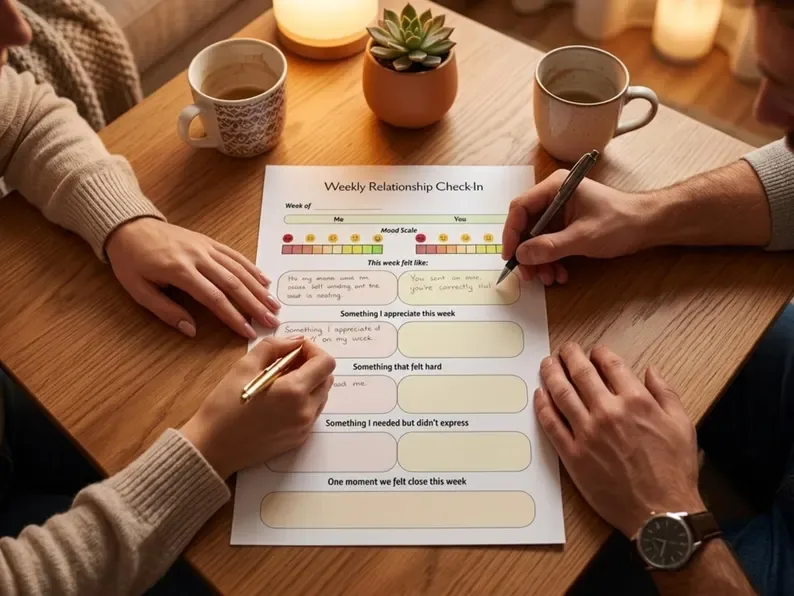
A weekly check-in is a short, structured conversation — fifteen minutes, once a week — that catches small issues before they grow. The five questions are simple: What went well this week? What felt hard? Is there anything you need from me next week? Is there anything we should plan together? And is there anything small I did that bothered you? Answered honestly, these five questions prevent most of the arguments couples ever have.
What it means: a regular, low-pressure space for the things that otherwise go unsaid. Why it matters: small frustrations mentioned weekly never become explosions. How to handle it: pick the same time each week, keep it short, and end with something kind — a plan, a thank you, a hug. What to avoid: using it as a courtroom; the check-in is for understanding, not for keeping score.
32. Communicating Through Travel and Holiday Stress

Holidays and travel are supposed to be relaxing, but they are also where couples argue most — tired, out of routine, spending money, making constant small decisions together. The pressure builds because expectations are high and patience is low. The prevention is a conversation before you go: what does each of you actually want from this trip, what are you willing to spend, and what will you do when you get tired and snappy?
Try saying this: ‘I think we both need a slow morning tomorrow — can we agree to that now?’ Avoid saying this: ‘You always ruin holidays’ — said at the airport, at midnight, in front of strangers. Agree in advance on a few simple things: one rest day, a rough budget, and permission to spend an hour apart without it meaning anything. The best trips are the ones where both people felt heard before the plane even took off.
33. Bringing Up a Recurring Issue Without Sounding Like a Broken Record

Some issues come back again and again — the same argument, the same habit, the same unmet need — and raising it for the tenth time feels hopeless. The problem is usually not that your partner did not hear you; it is that the conversation never reached a real agreement. ‘Please try harder’ is not a plan. ‘Let us agree that you will do the school run on Tuesdays and Thursdays’ is a plan, and plans can be kept, checked, and adjusted.
Try saying this: ‘This keeps coming up, so I think we need a different solution, not just another talk — what would actually work for you?’ Avoid saying this: ‘I have told you a hundred times’ — it may be true, but it closes the conversation. Signs it is working: the issue comes up less often, and when it does, you both talk about the plan instead of the blame.
34. Keeping Humour Alive in Hard Conversations

Humour is not the opposite of taking things seriously — it is one of the ways serious things become bearable. A gentle joke at the right moment can release the tension in a hard conversation and remind you both that you are on the same side. The key is that the humour is shared, never aimed at your partner: laughing together is connection, laughing at your partner is a wound.
What it means: lightness keeps hard conversations human. Why it matters: couples who can laugh together during a difficult talk recover from arguments far faster. How to handle it: use humour to soften the moment, not to dodge the topic — a smile, then back to the point. What to avoid: sarcasm, eye-rolling, and jokes about the very thing your partner is upset about. When in doubt, laugh at the situation, never at the person sitting across from you.
How can I communicate better in a relationship?
Start with the basics: listen fully before you reply, say what you need in plain words, and use ‘I feel’ statements instead of blame. Add one daily habit — a short evening talk with phones away — and you will notice a difference within a week. Good communication is a skill, not a talent, and it improves with small, regular practice.
What is the best way to start a difficult conversation with my partner?
Pick a calm moment when you are both rested and unhurried, and give a gentle heads-up first: ‘There is something I would like to talk about — would after dinner work?’ Start with your own feeling and a specific situation, not a general accusation, and keep the conversation about one topic at a time.
Why does my partner shut down during arguments?
Shutting down usually means feeling overwhelmed, not feeling indifferent. When emotions run too high, the brain effectively goes offline, and silence is the result. The kindest response is to pause the conversation, agree a time to return — twenty minutes is a good default — and come back when you are both calmer.
How do I get my partner to open up more?
Make it safe to talk by listening without judging, fixing, or interrupting. Ask gentle, specific questions instead of ‘What is wrong?’, give them time to find words, and respond warmly when they do share. People open up where they feel heard, not where they feel interrogated.
What are signs of good communication in a relationship?
You both feel heard after conversations, even difficult ones. You can disagree without name-calling or silent treatment, you ask for what you need directly, you apologise and repair after arguments, and small problems get mentioned early instead of exploding later. Feeling understood is the clearest sign of all.
How often should couples talk about their relationship?
A short daily check-in of a few minutes, plus a slightly longer weekly conversation of about fifteen minutes, works well for most couples. The daily talk keeps you connected; the weekly one catches small issues before they grow. The exact timing matters less than the regularity.
Is it normal to argue in a healthy relationship?
Yes — every couple argues, and healthy couples argue about real things, one topic at a time, without attacking each other’s character. What matters is how you argue and how you repair afterwards. A relationship with no disagreements at all usually means someone has stopped saying what they think.
How can we communicate better about money?
Talk about money when you are calm, not after a surprise bill. Hold a short weekly money check-in, agree on a small amount each person can spend without asking, and frame it as a shared plan rather than a blame session. Most money arguments are really about security and values, so talk about those too.
What should I do when my partner will not talk to me?
Give them a little space first, then try a gentle, specific invitation: ‘I can see something is bothering you. I am here when you are ready — would later tonight work?’ If the silence lasts for days or happens after every disagreement, it is worth talking about the pattern itself in a calm moment, or together with a counsellor.
Can communication really save a struggling relationship?
Better communication can improve almost any relationship, because most distance grows from things left unsaid. But communication alone cannot fix everything — if trust has been broken or the same hurt keeps repeating, rebuilding takes time, patience, and sometimes professional support. Asking for that help together is itself a powerful act of communication.
Conclusion: Say It So They Actually Hear It
Communicating better in a relationship is not about finding the perfect words — it is about making it safe for both of you to be honest, and then listening like it matters. The small habits in this guide — a ten-minute evening talk, a phone put face-down, an ‘I feel’ instead of a ‘you always’ — are the real foundation, and the bigger skills, from timing hard conversations to repairing after a fight, are built on top of them. No couple gets it right every time; the couples who last are the ones who keep coming back to the conversation.
Start with one change tonight. Pick the idea that felt most like your relationship — the evening ritual, the pause before replying, the honest apology without a ‘but’ — and try it for a week. Notice how your partner responds, ask them what they need too, and keep the conversation going. You do not need to fix everything at once. You just need to say it so they actually hear it — and to hear them the same way.
